The Psychology of Nightlife: Why We Crave the Dark
There is a myth about nightlife — that it is simply a loud room designed to help you consume expensive drinks and escape the exhaustion of the workweek. It is a persistent assumption. And it is entirely wrong.
We do not step into a premium nightclub to forget who we are. We go to find a sharper, more elevated version of ourselves. The psychology of nightlife runs far deeper than a heavy bassline and a neon sign. It is driven by a fundamental human need for connection, status, and an atmospheric shift that daylight simply cannot provide.
Kolkata’s affluent professionals, entrepreneurs, and creatives do not just want a place to stand with a drink in hand. They have experienced the underground clubs of Berlin and the velvet-rope exclusivity of Manhattan. They understand that a truly exceptional night out is a curated psychological experience. It is an environment where music, lighting, and hospitality merge to alter your state of mind.
To understand why we love going out after dark, you have to look past the surface. You have to look at the psychology of the room.
The Nightclub as the Ultimate Third Place
Sociologists often talk about the concept of the "third place." The first place is your home. The second place is your work. The third place is where you gather to build community, exchange ideas, and establish your social identity.
For decades, Kolkata relied on cafes, heritage lounges, and crowded bars to act as its third places. But the modern, global-standard nightlife venue serves as an elevated third place for the city's new guard. It is a sanctuary for those who refuse to settle for ordinary. When you enter a highly curated venue, you are stepping into a space designed specifically for high-status social bonding.
The right third place does not just host a crowd. It defines it. By gathering culture builders, industry leaders, and tastemakers in a single room, a premium nightclub creates an atmosphere of exclusive belonging. You are not just going out. You are taking your place among your peers.
The Power of Liminality
In psychology, liminality refers to the threshold — the space between one state of being and the next. A great nightclub is a masterclass in liminality.
When you walk through the doors, you leave the obligations of the day behind. The transition is physical and mental. The architecture of the venue, the warm amber lighting, and the immediate shift in acoustics signal to your brain that the rules of the outside world no longer apply. You are in a liminal space. Identity becomes fluid. Confidence spikes.
This psychological shift is what makes true social bonding possible. In a liminal environment, the barriers that keep us guarded during the day begin to dissolve. We connect faster. We speak louder. We share moments of synchronized energy on the floor that would feel entirely out of place anywhere else.
Sensory Stimulation: Sound, Light, and Behavior
Every element of a premium night is intentional. The sensory stimulation in a room dictates how the people inside it behave.
Why the dark? Why the volume? It is not accidental. Dim lighting lowers visual inhibitions, increases physical proximity, and creates a sense of intimacy even in a room of hundreds. It forces you to rely on other senses, drawing you deeper into the present moment.
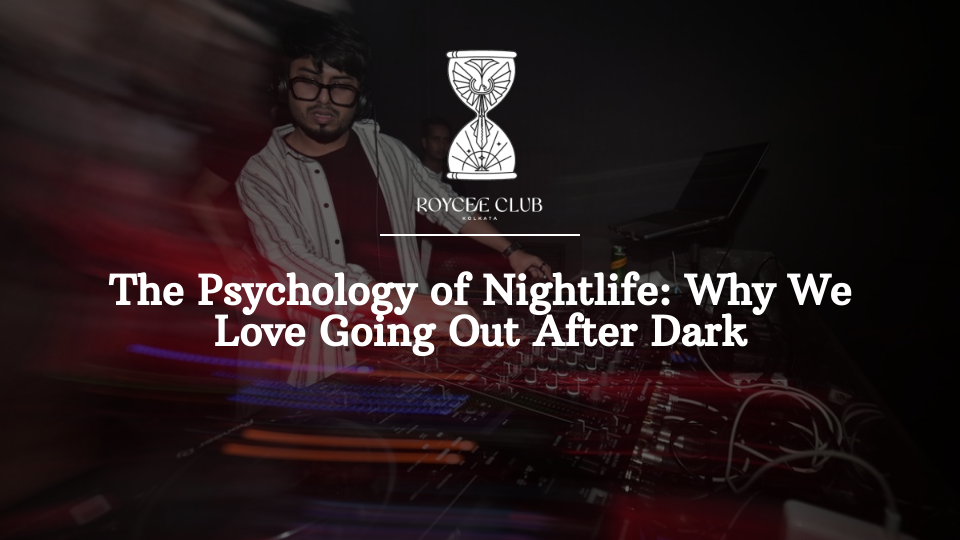
The music plays an even more critical role. Most clubs book DJs to play familiar hits at high volumes. But elite venues curate artists who understand the psychology of sound. A meticulously engineered sound system does not just push noise into the room. It wraps around you. The bass finds you before the light does. Low-frequency sounds actually synchronize the heartbeats and movements of the crowd, creating a collective euphoria. It is not just hearing music. It is feeling it dictate the rhythm of the room.
Social Proof and the Right Room
We are inherently social creatures, wired to seek out social proof. We look to others to validate our choices, our status, and our environment.
This is why crowd curation is not a marketing gimmick; it is the product. The psychology of nightlife relies heavily on who is standing next to you. If the room is filled with the right mix of energy, intention, and respect, the night works. If it is overcrowded with people seeking cheap thrills, the psychological magic breaks.
Exclusivity is functional. It protects the atmosphere. When a venue carefully curates its guest list and respects the room, it signals to every person inside that their presence has value. They feel validated. They belong.
Where the Night Gets a New Standard
The best energy of any night does not happen before midnight. It happens when the early crowd has gone home, the music shifts from warm-up to peak, and the room finds its rhythm. It requires a venue that understands the psychology of the night and gives it the time it needs to build.
Kolkata’s nightlife audience has evolved. They demand a space where the music is curated, the crowd is composed, and the hospitality is elevated. They demand a venue that operates until 4 AM, giving the night enough room to become something extraordinary.
You do not visit a place like this. You arrive. And when you leave, the night leaves with you.